Arrangements and Volumes
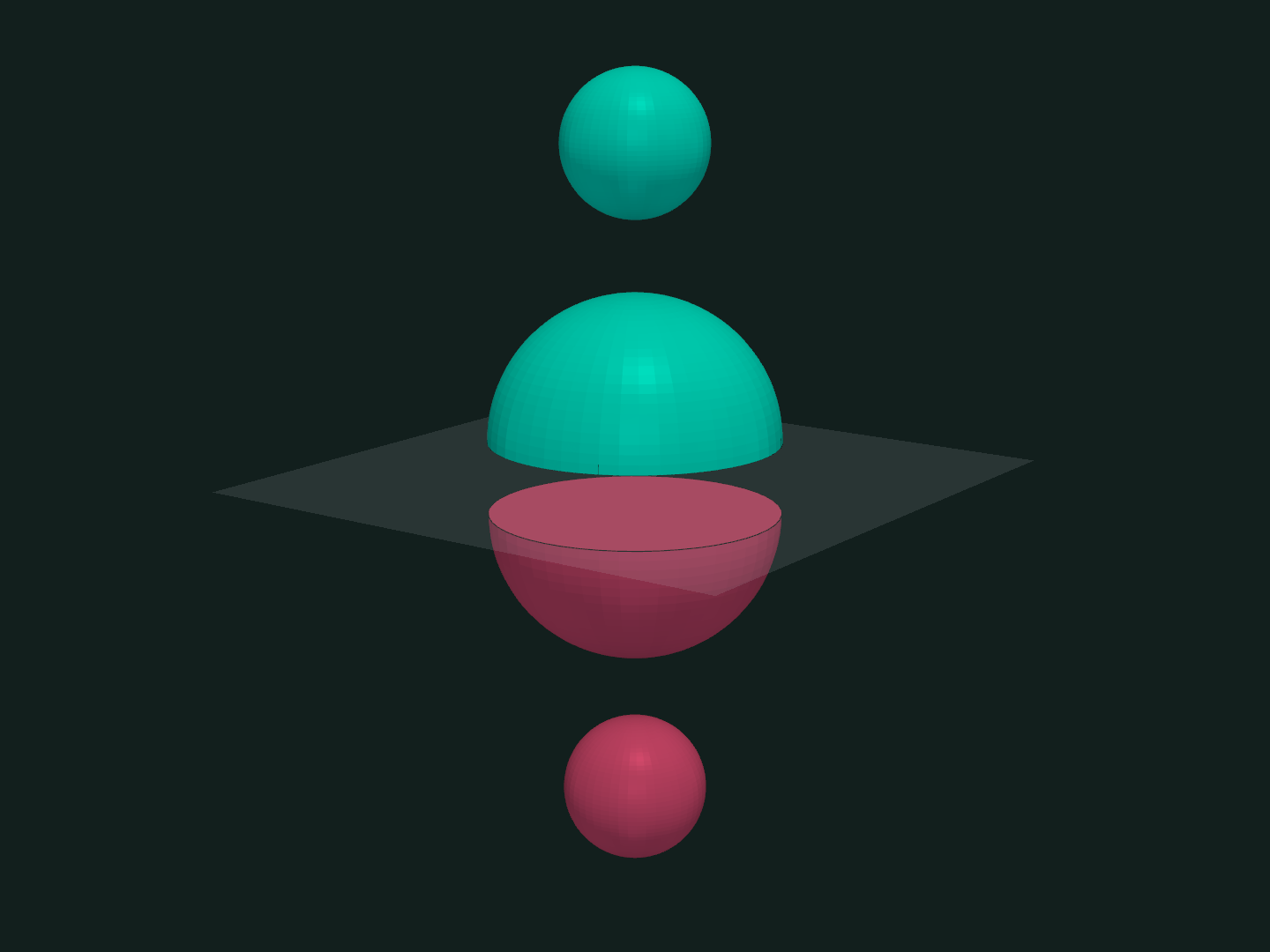
This walkthrough takes a small CSG-flavoured scene — two overlapping cubes and a bisecting plane — and pushes it through trueform's arrangement pipeline. The result is a set of closed, manifold, outward-oriented volumes, each labelled by which signed side of the plane it sits on.
Source: arrangements.cpp
What the pipeline does
mesh_arrangements splits every face at every intersection and merges everything into one mesh, tagging each face with its source operand. make_domain_labels then partitions space into bounded volumetric regions ("domains"). split_into_domains finally emits one watertight outward-oriented submesh per domain. We add a small post-step that reads the slot convention on knife faces to label which volumes are above vs below the knife.
Building the scene
Two unit cubes offset along the x-axis so they overlap in the middle, and a 4×4 plane on z=0. The cubes are positioned via lazy frames (no point copies); the plane sits at its build position.
auto cube0 = tf::make_box_mesh<Index>(Real(2), Real(2), Real(2));
auto cube1 = tf::make_box_mesh<Index>(Real(2), Real(2), Real(2));
auto plane = tf::make_plane_mesh<Index>(Real(4), Real(4));
auto f0 = tf::make_frame(tf::make_transformation_from_translation(
tf::vector<Real, 3>{Real(-0.5), Real(0), Real(0)}));
auto f1 = tf::make_frame(tf::make_transformation_from_translation(
tf::vector<Real, 3>{Real( 0.5), Real(0), Real(0)}));
auto fid = tf::make_frame(tf::make_transformation_from_translation(
tf::vector<Real, 3>{Real(0), Real(0), Real(0)}));
auto p0 = cube0.polygons() | tf::tag(f0); // tag 0
auto p1 = cube1.polygons() | tf::tag(f1); // tag 1
auto p_knife = plane.polygons() | tf::tag(fid); // tag 2
decltype(p0) forms[] = {p0, p1, p_knife};
The two cubes alone produce three bounded regions (cube0-only, intersection, cube1-only). The plane bisects all three, so we expect six bounded domains.
Building the arrangement
auto [arr_raw, tag_labels_raw, face_labels_raw] =
tf::make_mesh_arrangements(tf::make_range(forms, forms + 3));
The return is three buffers:
arr_raw— the merged triangle mesh with all intersections resolved.tag_labels_raw[f]— which input operand facefcame from (0,1, or2here).face_labels_raw[f]— which face within that operand it came from.
For our scene this produces 176 faces, 48 points before cleaning.
Cleaning and reindexing tags
tf::cleaned does three things in one pass: it merges coincident vertices within a tolerance, drops topologically degenerate triangles (faces that collapse to a point or edge after merging), and removes duplicate triangles. With tf::return_index_map it also returns an index map describing exactly what happened to each face, so per-face attributes like tag_labels_raw can be reindexed through it to stay aligned with the cleaned mesh:
auto [arr, face_im, point_im] =
tf::cleaned(arr_raw.polygons(), tf::epsilon<Real>, tf::return_index_map);
auto tag_labels = tf::reindexed(tf::make_range(tag_labels_raw), face_im);
tf::reindexed runs the index map over the range and emits a new buffer with face_im.kept_ids() worth of entries — exactly the right length for the cleaned mesh. In our scene cleaning takes us from 176 → 114 faces, 48 → 40 points.
tf::index_map returned by index-destructive operations is the canonical handle.Computing domain labels
auto dl = tf::make_domain_labels(arr.polygons(),
tf::domain_config::ignore_open_fragments |
tf::domain_config::exclude_outer_shell);
Two flags shape the output:
| Flag | Effect |
|---|---|
ignore_open_fragments | Park face-sides bounding open fragments (in our scene: the plane's outer ring that pokes outside the cube union) at the sentinel label. |
exclude_outer_shell | Fold the unbounded universe domain into the same sentinel. |
What survives is the bounded interior. For our scene dl.n_domains == 6. Each face f carries two domain ids:
dl.labels[f][0]— the domain that containsfwith reversed winding (the sidef's stored normal points INTO).dl.labels[f][1]— the domain that containsfwith forward winding.
That two-slot encoding is what makes the signed-side selection in the next step trivial.
Extracting the volumes
auto [volumes, comp_labels] = tf::split_into_domains(arr.polygons(), dl);
volumes[i] is a tf::polygons_buffer — a standalone watertight, manifold, outward-oriented submesh for the domain comp_labels[i]. split_into_domains reverses side-0 emissions and keeps side-1 emissions, so each cap face ends up pointing outward of its volume by construction.
For our scene: 6 volumes.
Selecting volumes by signed side of the knife
The knife (tag 2) has stored normal +Z. By the slot convention above, labels[f, 0] for an interior knife face is the domain on the +Z side, and labels[f, 1] is on the −Z side. Walking all interior knife faces and collecting the unique domain ids per side gives us the split:
tf::buffer<Index> above_ids, below_ids;
tf::generic_generate(
tf::zip(tag_labels, dl.labels), std::tie(above_ids, below_ids),
[&](auto elem, auto &buffers) {
auto [tag, sides] = elem;
if (tag != Index(2)) return;
auto above = sides[0];
auto below = sides[1];
if (above >= dl.n_domains || below >= dl.n_domains) return;
auto &[ab, be] = buffers;
if (std::find(ab.begin(), ab.end(), above) == ab.end())
ab.push_back(above);
if (std::find(be.begin(), be.end(), below) == be.end())
be.push_back(below);
});
auto sort_unique = [](tf::buffer<Index> &b) {
tbb::parallel_sort(b.begin(), b.end());
b.erase_till_end(std::unique(b.begin(), b.end()));
};
sort_unique(above_ids);
sort_unique(below_ids);
A few things worth pulling out:
tf::zip(tag_labels, dl.labels)walks both ranges in lockstep — no index gymnastics. Each yielded element is(tag, two-domain-slot).tf::generic_generatewith the multi-buffer variant runs the body in parallel using thread-local buffers, then merges intoabove_ids/below_idsin one pass.- Inner
std::finddedup keeps each thread-local buffer small (capped atn_domainsper side), so the post-mergeparallel_sort+std::uniquehas almost nothing left to do. - Sentinel skip (
>= dl.n_domains) drops the knife faces that landed in the outer ring — those don't bound any real domain.
For our scene: 3 above, 3 below. The cube0-only, intersection, and cube1-only volumes each contribute one upper and one lower half.
Mapping domain ids to volume indices
comp_labels[i] tells us which domain volumes[i] represents. We invert that with one parallel pass:
tf::buffer<Index> domain_to_idx;
domain_to_idx.allocate_and_initialize(
static_cast<std::size_t>(dl.n_domains), Index(-1));
tf::invert_map_with_nones(comp_labels, domain_to_idx, Index(-1));
tf::invert_map_with_nones writes domain_to_idx[comp_labels[i]] = i in parallel. Domain ids that don't appear in comp_labels keep the pre-filled sentinel -1.
Writing volumes and verifying
auto write_side = [&, &vols = volumes](const tf::buffer<Index> &ids,
const char *prefix) {
for (std::size_t k = 0; k < ids.size(); ++k) {
auto v_idx = domain_to_idx[static_cast<std::size_t>(ids[k])];
const auto &vol = vols[static_cast<std::size_t>(v_idx)];
auto fname = std::string(prefix) + "_" + std::to_string(k) + ".stl";
tf::write_stl(vol.polygons(), fname);
std::cout << " wrote " << fname << " (faces=" << vol.faces().size()
<< ", closed=" << tf::is_closed(vol.polygons())
<< ", manifold=" << tf::is_manifold(vol.polygons()) << ")"
<< std::endl;
}
};
write_side(above_ids, "above");
write_side(below_ids, "below");
tf::is_closed checks that every edge is shared by exactly two faces (no boundary), and tf::is_manifold checks that no edge is shared by three or more. Every output volume should print closed=1, manifold=1 — the structural guarantee split_into_domains makes is verified at the boundary.
Running the example writes six STL files and prints:
=== Arrangement ===
Faces: 176
Points: 48
=== Cleaned ===
Faces: 114
Points: 40
=== Domain labels ===
Bounded domains: 6
Volumes extracted: 6
=== Signed side of the knife ===
Above (+normal): 3 volumes
Below (-normal): 3 volumes
wrote above_0.stl (faces=22, closed=1, manifold=1)
wrote above_1.stl (faces=24, closed=1, manifold=1)
wrote above_2.stl (faces=22, closed=1, manifold=1)
wrote below_0.stl (faces=24, closed=1, manifold=1)
wrote below_1.stl (faces=22, closed=1, manifold=1)
wrote below_2.stl (faces=22, closed=1, manifold=1)
The 24-face volumes are the intersection halves — they pick up parts of both cubes' inner walls, so their boundary surface is slightly larger than the cube-only halves.
Summary
| Step | API | What you get |
|---|---|---|
| Build arrangement | tf::make_mesh_arrangements | One merged mesh + tag_labels + face_labels |
| Clean | tf::cleaned(..., tf::return_index_map) | Cleaned mesh + face/point index maps |
| Reindex attributes | tf::reindexed(range, face_im) | Per-face attributes aligned to cleaned mesh |
| Label domains | tf::make_domain_labels(polygons, flags) | Per-face two-slot domain ids |
| Extract volumes | tf::split_into_domains | Closed, manifold, outward-oriented submeshes |
| Side selection | dl.labels[f][0/1] per knife face | Domain ids on each signed side |
| Verify | tf::is_closed / tf::is_manifold | Structural sanity per output |